UPDATE: Some of the turntables we recommended have been replaced and/or discontinued plus we’ve seen a lot of requests for different turntables at budgets not covered in this guide. For that reason we recently posted an updated guide. Check out our guide to the Top 5 Best Recommend Turntables and Stereo Systems.
So, you previously read Turntable Kitchen’s Top Ten Reasons to Buy a Turntable, and are now thoroughly convinced that you need a record player, but are looking for a place to start. Buying a turntable can be a daunting experience. After all, there is a lot to consider. For example, do you want belt-driven or direct-drive? Also, you need to decide if you want a turntable with or without a built-in preamp. Do you want to start an audiophile quality setup that can be upgraded over time, or do you just want something simple that will allow you to play records? Ultimately, after considering those factors, the answer as to which turntable you’ll want will primarily depend on two factors: your budget and what your goal for your system is (Note: this article presumes you aren’t seeking a DJ-style deck which are designed with different considerations than a turntable intended as a hi-fi system).
I’ve broken my recommendations down into a few different categories, starting with a recommendation for the beginner record collector, moving to recommendations for archivists (meaning you want a way to transfer vinyl to MP3), followed by my recommendation for starting an audiophile quality stereo system, and ending with my tips for selecting your own turntable if the ones I recommend don’t appeal to you.
And, remember, even the best turntable is only as good as the speakers you use it with. Check out our newest guide: 3 Audiophile Speakers That Will Make Your Music Glow.
I Want a Basic Turntable To Listen To My Small Collection of Records
TK Recommends:
* $129
* Belt-Drive
* Built-in Preamp
* RCA outputs
* Upgradeable
* Available from Amazon.
If you are on a budget, but want a good, basic turntable that will let you play those pretty 7” records you receive in your Turntable Kitchen Pairings Box each month, I recommend the AT-LP60-Automatic Turntable. It is a solid starter turntable. It is belt-driven and includes a built-in preamp and line-level RCA outputs, which means it is good to go straight out of the box and won’t require you to purchase any other equipment. You can connect this turntable to a home stereo system. Compared to the other turntables in this range, you’ll get very good sound reproduction when listening to your record collection. You can upgrade many of the components, such as the stylus, to improve the overall performance of the player.
I Want a USB Turntable To Convert LPs into MP3s
TK Recommends:
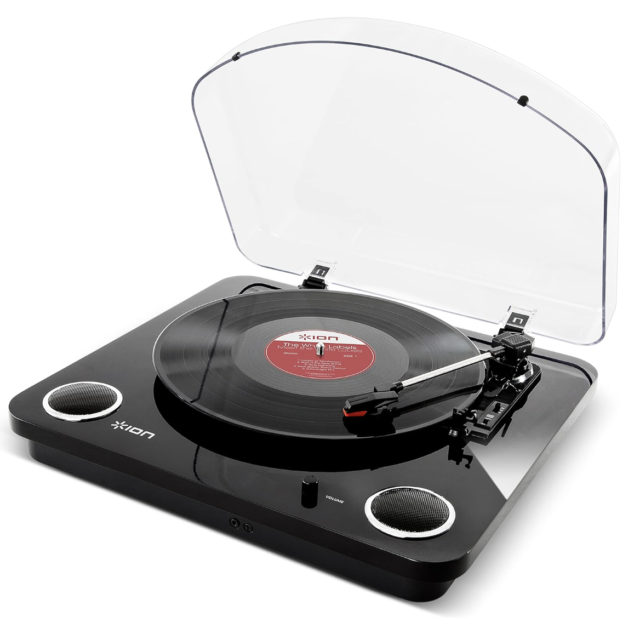
Ion iPTUSB Turntable * see comments
* $129.99
* Belt-Drive
* USB output
* Built-in speaker
* Available from Amazon (discontinued).
* $249.99
* Belt-drive
* USB output
* Built-in preamp
* Available from Amazon.
Pro-ject Essential USB Turntable
* $399.99
* Belt-drive
* Audiophile Quality
* USB output
* Upgradeable
* Available from Amazon.
Personally, I’m not crazy about USB to PC turntables for converting vinyl records into MP3 format. Most people I know who buy them don’t use them for that purpose very often (if ever) and instead just use them to play records. And, of course, the feature will cost you – either in terms of the overall quality of your turntable or in price. Besides, many contemporary records include digital downloads with purchase of the vinyl anyways. However, if you have a collection of old, rare records, this might be the easiest way to transfer the music at listenable quality.
If you are seeking a turntable for this purpose, the next question you need to ask is whether you are simply seeking a basic, starter turntable to transfer your music or looking for a high-end audiophile piece of equipment to also make your music sound glorious. I recommend three turntables for this section, based on the criteria you’re looking to fulfill. The Ion is the cheapest of the three and will do a good job of both playing your records and transferring them digitally (however, see the comments section: one reader noted that there are speed issues and it may not be possible to bypass the built in preamp which isn’t very good quality). The Music Hall USB-1 will do a better job at playing your records, and the Pro-Ject Essential USB Turntable is the somewhat pricier audiophile choice that will make your music sounds mind-blowing.
I Want an Audiophile System To Make My Records Sound Amazing
TK Recommends:
Pro-ject Debut Carbon Turntable
* $369-399 (depending on color)
* Belt-Drive
* Very upgradeable
* Audiophile Quality
* Sexy
* Available at Amazon.
If you’re really into your music and want a turntable that can change the way you hear your favorite albums, then you are going to want to get an audiophile quality deck. Keep in mind, they aren’t cheap, but they’re worth the price if you’re serious about building out your music collection. Even an entry-level audiophile quality turntable is going to cost you at least $350 for the turntable itself, and it won’t have a built-in preamp, so you’ll need to buy that, too. Odds are, you are going to need a phono-in unless your integrated amp or amplifier has one built-in. And, of course, you’ll eventually need to buy good speakers because even a great turntable will sound crappy out of bad speakers. If you’re prepared and excited to start building out your record-listening collection, allow me to make some recommendations.
The three most commonly recommended entry-level audiophile turntables are the Pro-Ject Debut Carbon, the Rega RP1, and the Music Hall MMF 2.2. If possible, your best bet is to go to an audio-equipment store and give each a listen before deciding on which one you want. Each is a fantastic turntable that will breathe new life into your record collection.
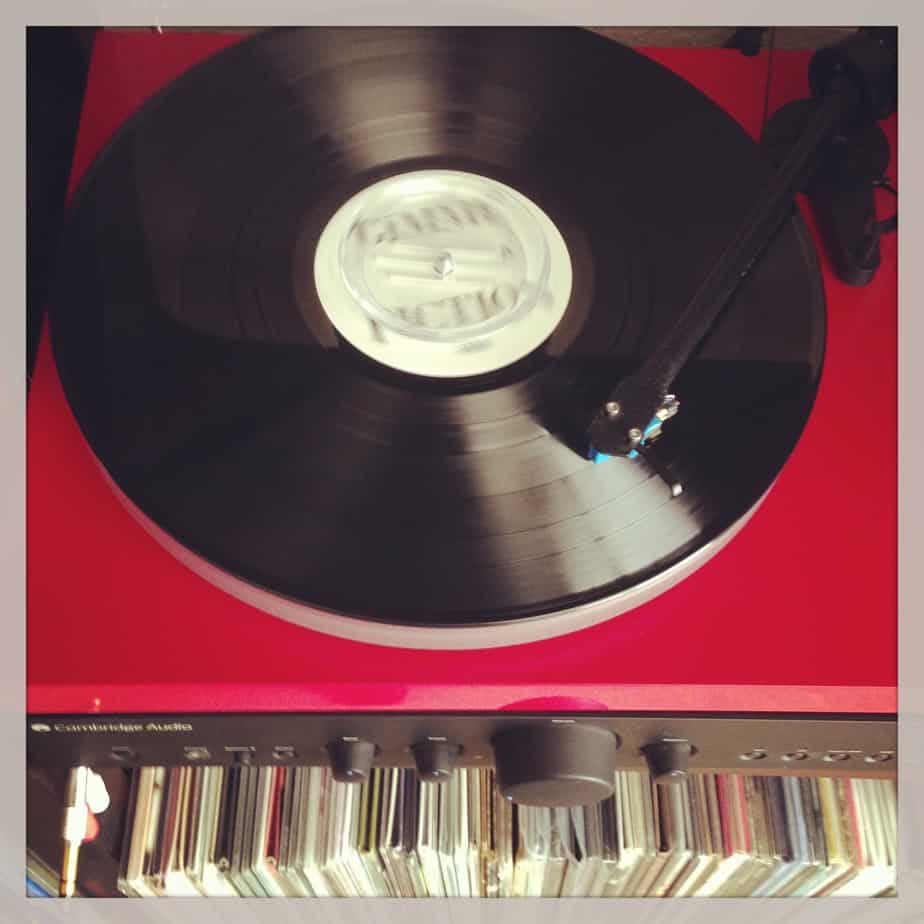
When selecting mine, I went out to local audio-equipment stores and gave each of them a test drive using the same records, integrated preamp, cables and speakers for each test run. When all was said and done, I left with a slight, but certain, preference for the sound from the Debut III (now upgraded and called the Debut Carbon). It was warm, clean and very alive. Not only that, but for me, it was the sexier looking turntable of the three. I bought it in red, but it is also available in several other colors including silver, black, white, blue, green and yellow. The RP1 was a close second, but it was a definite second place and also more expensive. Thus, I recommend the Pro-Ject Debut Carbon (the update to the Debut III).
Personally, I started my system with a Cambridge Audio azur 340A integrated pre-amp, a Cambridge Audio phono-in, and a pair of PSB speakers. It sounds great to my ears. I later updated my Debut with an acrylic platter and the Pro-Ject Speed Box (which increases bass performance and improves and automates speed control). Next I plan to purchase a new cartridge and better speakers.
Tips For Selecting Your Own Turntable
Not interested in any of the ones I recommended above? Maybe you just want to hit eBay to buy a vintage turntable. No worries, here are some tips to help you select your own.
Belt-drive vs. Direct-drive
I recommend belt-drive turntables. If you aren’t a DJ, the advantages of direct-drive turntables are insignificant, but the disadvantages are numerous – especially if you aren’t ready to dive into the high-end market (and even then, I generally recommend belt-driven turntables). This is because direct-drive turntables can transmit noise from the motor and bearing to the stylus, which means the sound produced isn’t as clean as it could be. Many direct-drive turntables also can have issues related to speed that cause pitch variations in playback (a.k.a. wow and flutter). Conversely, the belt on a belt-driven turntable absorbs vibrations that may otherwise be picked up by the stylus.
Built-in amplifiers
First, let me say that I have no intention of getting deep into a discussion of preamps, integrated preamps, and amplifiers. There is a lot to cover on the topic, and I want to keep this about selecting a turntable. However, when selecting a turntable, you’ll need to decide whether you want to purchase a turntable with a built in preamp or not.
I’m going to try to keep this as straightforward as possible, which means I’m glossing over a lot of stuff here. With that said, here is the basic gist of it: without a preamp, the output from your turntable won’t be loud enough to be picked up through normal stereo equipment/speakers. Personally, I don’t like turntables with built-in amplifiers and I’d rather buy my own. With a built-in preamp you are stuck with the quality of the preamp built-in to the turntable, which probably isn’t very good. Audiophile equipment generally won’t include that option anyway. However, buying a turntable with a built-in preamp saves you the cost of having to buy a separate preamp. Thus, the bottom line is this: if you are on a tight budget, go with a turntable with a built-in preamp; if you are going middle of the road on a system you can improve over time, I’d recommend buying a separate integrated amp (combines the preamp and amplifier)(hint: you may find cheap “vintage” equipment on eBay to get you started); and if you are looking to build the perfect system you’ll probably want to go with a separate preamp, amplifier, turntable, and phono-in. As I mentioned above, I started my system with a Cambridge Audio Azur 340A integrated pre-amp, a Cambridge Audio phono-in, and a pair of PSB speakers.
If you’re looking for speaker recommendations, we’ve got you covered. Check out our top 3 audiophile quality speaker systems.
Meanwhile, if you’re looking for preamps, speakers, phono stages, and/or updated turntable recommendations, check out our brand new guide to building a turntable stereo system: https://www.turntablekitchen.com/2014/10/turntable-kitchens-top-6-recommended-turntable-systems/